Review by: dustbunna
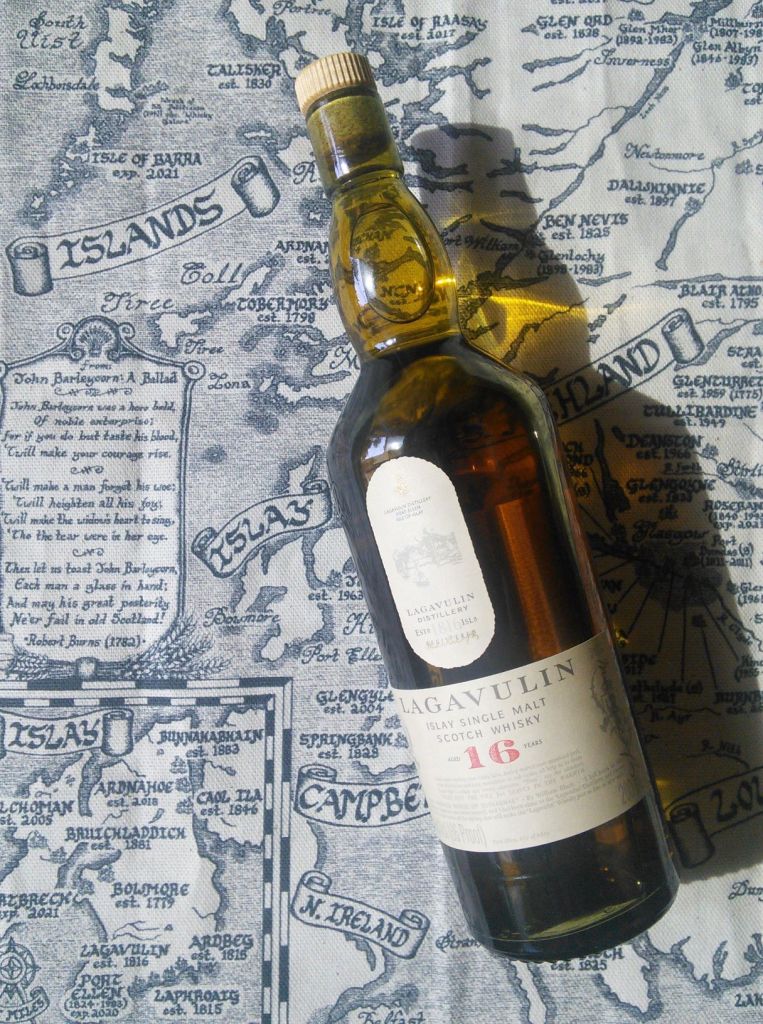
Quick story time: Lagavulin 16 was the very first Scotch whisky I ever tasted, single malt or otherwise, and on occasion I still order it in bars in memory of a friend who first introduced it to me and has since passed. As a remembrance, and as a touchstone for where my tastes in whisky have wandered in the meantime, this is an important malt to me, and it seems right to come back to review it now with more whisky experienced in the interim.
WARNING: LONG AND NERDY DISCUSSION AHEAD.
Because while this whisky is absolutely everywhere on the whisky subs, we don’t really dig much into it. There are exceptions, of course, but anybody who goes searching for Laga 16 online quickly finds that broad swaths of reviewers frame it as a baptism into the world of peated Scotch, for better or for worse… or else it comes much later in the journey, after the discovery of heavier hitters and more complex flavors, to be written off as just okay, maybe a bit soft.
I find it striking that Lagavulin’s entry-level flagship malt is also the oldest readily available expression in their entirely age-stated/vintage-stated core range (the Distillers Edition is often the same age or a bit younger.) We don’t often talk about how weird that is. There aren’t even that many entry-level bottles that are 16 years old. Everything else the distillery has put out in the past decade or so, besides some pricey one-time-only releases and distillery-only bottlings, is younger and generally higher ABV, suggesting they are not designed to appeal to the mass-market. The cost of the 16yr where I am, in the US, has now shot up, but for a long while it was hard to name another Islay at that age that could be found at a similar price– even in a market where it was previously over $100, still relatively few options.
Whenever Laga 16’s cask makeup comes up, the conversation usually goes “there’s some ex-bourbon and ex-sherry involved” and stops there, mostly because Lagavulin doesn’t tell us. That was the extent of what I thought about it as well, but after spending time with this 200mL bottle and taking my usual time-stratified notes (yes, there is still a review coming), I started to look and see if anyone had written much about what exactly is in there. I found this interesting comment on Reddit in a post asking about the casks a year ago:
“Diageo doesn’t officially disclose the cask types of the Lagavulin 16 but when I have asked people at the distillery they’ve said it’s first fill and refill bourbon and very little to no sherry casks. There’s a common myth among consumers that there is some good proportion of sherry casks going into the 16. I think it’s a myth that Diageo is only too happy to allow to perpetuate without actually commenting on the cask composition of the whisky. I listened to a podcast where the host waxed poetic about the richness of the sherry influence in the 16 and the Diageo brand ambassador just stayed silent neither confirming nor denying anything.“
There’s also this story from David Othenin-Girard, from a 2013 distillery tour on the K&L Spirits Journal:
“There is some controversy over what percentage of Lagavulin is aged in sherry butts. When we walked into the warehouses, we noticed almost exclusively sherry butts being aged onsite. When we mentioned this revelation to our hosts, how we were excited to finally know the truth, they corrected us. These were not Sherry Butts so much as they were European and American Oak Casks that happened to be in the shape of a sherry butt. This distinction was made to emphasize the practice of wood reconditioning. Basically, when they reuse certain barrels at Diageo, they will strip the wood and retoast the barrels. So, in effect there is very little sherry influence left in these oak casks despite the fact they almost certainly once held sherry…. This strategic technique was a point of great pride for our hosts, not only because it saved them money, but also because it was ecologically more advantageous. The goal is to have casks that last as long as it takes an oak tree to grow (approximately 100 years) an admirable goal, but perhaps the least romantic thing I’ve ever heard. We always talk about wanting first or second fill barrels, but these guys are figuring out how to use a barrel 8 or 10 times.”
These are interesting to me, because both mention inquiries made about casking specifically with folks at the distillery. Taken together, one might speculate that Diageo is coy about the sherry maturation idea because the vatting is really made up of many different refills of ex-bourbon as well as nth-refill/reconditioned ex-sherry casks. If true, that suggests that Lagavulin’s wood management resembles Glenfarclas in its efficiency, and might explain how they can keep releasing a 16yr at an even-sort-of-affordable price as their entry malt. I’d be curious to hear everybody’s thoughts about all this– wonder also if it might be related to the general talk I see from time to time of significant batch variation and/or bottle degradation in this whisky, but I’m not sure.
In the meantime, let’s (finally) get to the notes.
Distillery: Lagavulin.
Bottler: Distillery bottling.
Region: Islay.
ABV: 43%.
Age: 16 years. Bottled in 2018.
Cask type: Ex-bourbon and nth-refill recharred casks.
Price: $13 USD (200mL bottle).
Color added. Chill-filtered.
Bottle open across approx. 1 month, notes taken leisurely across that period. Bold notes taken beneath the shoulder, regular-formatted notes taken further into the bottle past the halfway point, italicized notes taken towards the heel.
Nose: pipe smoke, river stones, overripe orange, a bit of candied lemon, iodine, faint cherry wood.
Palate: thin ~ soft, earthy, leather, with a few drops of water seaweed and orange peel emerge, brine, faint pepper and minerals.
Finish: medium length ~ lingers with more pipe smoke and minerals, smoked fish in the background, a touch of sweet mint on the tail end.
Conclusion: Those supposed nth-refill/reconditioned sherry casks in the vatting might also go some way to explain why there’s very little obvious sherry influence that I can detect. I don’t get any of those strong bacon/barbeque-directed notes that I associate with sherry meeting peat (though others have spoken to this, so it could be stronger or weaker from batch to batch.) Instead, the direction here is quite marine– fish, seaweed, brine, citrus, minerals, all wrapped in the image of smoking a pipe in a leather armchair (yes it’s a cliche, but a good one.) Lagavulin, unlike their southern Islay neighbors, seem more interested in showing off their distillate than in cask experiments– with the 8yr and 12CS being spirit-driven whiskies, I’d hazard a guess that this one is also mostly spirit-driven, just much, much softer due to the added years in quiet casks and the lower bottling strength.
Finally taking notes for this after having tasted it in bars for years was kind of a trip for me. I can say that while it is still an enjoyable and sentimental whisky, the 16yr was much more exciting when I was first getting into Scotch and hadn’t yet discovered the sheer diversity of flavors and experiences out there. And yet, despite being soft and rather thin, I keep coming back to it. Maybe that’s because its profile is singular and distinct, not easy to find elsewhere– most peat/sweet I’ve found to be less about elegance/balance and more about heavy flavor or heavy cask influence. Lagavulin 16 is unique… and I can’t help but be the 50,000th person to say if it were released without chill filtering and at 46-48%, I expect it would be exceptional and lure many a jaded enthusiast back for more.
Final Score: 80.
Scoring Legend:
- 95-100: As good as it gets. Jaw-dropping, eye-widening, unforgettable whisky.
- 90-94: Sublime, a personal favorite in its category.
- 85-89: Excellent, a standout dram.
- 80-84: Quite good. Quality stuff.
- 75-79: Decent whisky worth tasting.
- 70-74: Meh. It’s definitely drinkable, but it can do better.
- 60-69: Not so good. I might not turn down a glass if I needed a drink.
- 50-59: Save it for mixing.
- 0-49: Blech.


